Sunday, January 25, 2015

Famous People and the Paranormal VII; Abraham Lincoln


By Robin M. Strom-Mackey
President, Abraham Lincoln, aside from being one of America’s greatest leaders was also probably the country’s most accepting of the spiritual realm.   Honest Abe, as he was nicknamed, was a man of great personal convictions.  He left a lucrative career in the law to enter politics in order to halt the spread of slavery, a practice he felt abhorrent.  He was as equally invested in maintaining the union, and felt the country should not be divided.  The Civil War became his personal cross to bear, and accounts describe his dejection at the loss of so many lives.  Those who knew the president best verify that he felt the division of the country and the loss of life due to the Civil War keenly, as if each boy lost were his own.
Lincoln’s personal life was no life as no less riddled with tragedy and loss. It was during his presidency that he lost his own son; young Willie.  All told, his presidency was a period of extreme personal duress, and sleepless nights and stress quickly took their toll on his already craggy countenance. 
As the war progressed the president appeared to withdraw further into himself, and was described as acting melancholy and silent.  A man bearing the loss of so many souls could only be searching for answers to the universe’s deeper mysteries, and there is evidence that he did seek out guidance in those years from well-known spiritualists, many of whom were invited to the White House by the first lady herself.
 
Personal Loss
Lincoln’s personal losses were both devastating and life-changing.  His mother died when Lincoln was only a child, struck down by a frontier-epidemic called “Milk Sickness.” The willowy, Nancy Hanks Lincoln nursed family friends Tom and Betsy Sparrow who had succumbed to the illness, at which time she herself was infected.  Nancy died shortly after, leaving a husband and two children behind.  Lincoln, devastated by the loss, reportedly helped to build her coffin, and lower it into the ground.  Afterwards, Lincoln buried his head in his hands and wept for hours, despairing that he was now, “completely alone in the world.”
Lincoln funneled his despair into hard work, laboring at odd jobs to pay his way through college and law school.  It was in the law that Lincoln developed his greatest talents. He had both an ability for political maneuvering and a genius for oration and debate. Once he established his career he met his future wife, the young Mary Todd. After a rocky courtship beginning in 1839, Lincoln finally married Mary in 1842.
Mary Todd Lincoln
 The early years of their marriage were strained, however, with Lincoln’s constant and lengthy absences from home as he traveled on business. Nevertheless, Mary gave Abe four sons, Robert Todd Lincoln (1843-1926), Edward “Eddie” Baker Lincoln (1846-1850), William Wallace “Willie” (1850-1862) and Thomas “Tad” (1853-1871).  Eddie lived only to the age of four, and died shortly before the birth of Willie. Incidentally, Robert was the only son of the four to survive to adulthood.  He would follow in his father’s footsteps and became first a lawyer and eventually Secretary of War and Minister to Great Britain.  Oddly, Robert was probably the son least close to the president. He was born at a time when the Lincoln was constantly away on business and had very little contact with Lincoln as a child. When Robert turned 16 his father won the White House, but Robert was departing for school. Robert later reported that he had had about 10 minutes of the president’s attention while Lincoln was in the White House, as the President was constantly preoccupied.
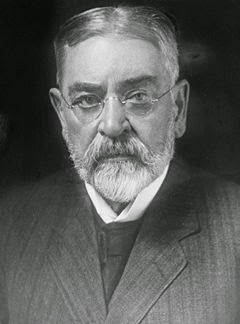
Robert Lincoln
Lincoln dedicated most of his early years with his own education in the law, and later at establishing his reputation as a lawyer. His law practice was extremely successful, and the more successful he became the further afield he went, trying cases the length and breadth of Illinois. He’d served a stint as a Congressman in the early 1840’s, but gave it up because of the demand on his time. He was adamantly against slavery, but he was satisfied with the Missouri Compromise which made slavery illegal anywhere west than the line drawn by the Louisiana Territory, as he felt that the future of the country resided to the west.
When that same compromise was challenged by a congressional act spearheaded by an old rival, Stephen Douglas, Lincoln felt that the time had come for another run at politics, he threw in his hat for Douglas’s senate seat.  A fiercely contested campaign ensued in which Lincoln and Douglas squared off in several heated debates, so heated in fact that they aroused the attention of the news media across the country.  Lincoln displayed his finest oratorical talents in eloquent and passionate arguments. At a time when passions throughout the country were running high, Lincoln spoke for reason and compromise.  Though he lost the seat to Douglas in the 1858 election, he had garnered the attention of many political pundits including the newly formed Republican Party. In May 1860, in Chicago, Illinois, Abe Lincoln became the Republican Party’s candidate for president.
Lincoln won the presidency handily in the Electoral College.  The popular vote, however, revealed a different story; a story of a country divided.  Lincoln gained just 40% of the popular vote, and the numbers were even grimmer in the south, where Lincoln won none of the popular votes.  He became a minority president.
In his home state of Illinois, however, the day of the election had a carnival atmosphere.  There was a parade which wound its way past Lincoln’s house and lasted for hours. Later there was a picnic with tubs of lemonade and roasted whole steers.  Clearly Illinois was proud of their presidential hopeful. An evening dinner was held with political allies, and then Lincoln repaired to the local telegraph office to await last minute messages.  In the very early hours it became clear that Lincoln had won the election in the Electoral College. After an intense and tiresome twenty-four hour marathon, Lincoln returned home.
The Prophetic President

Lincoln was exhausted. Too tired to remove his clothes, he lay down on the first flat surface he could find, a small settee. Near the couch was a bureau with a mirror on top.  Lincoln was shocked at his appearance in the mirror. His face looked wan and thin and bleached of all color.  When he later recounted this to his friends they suggested he grow a beard to hide the narrowness of his countenance and to give him a more presidential image. It was then that Lincoln felt he had his first vision, what he felt later was a vision of prophetic import. He realized that when he looked in the mirror what he saw was two distinct images of himself superimposed. He could tell there were two images because they didn’t quite align with one another, and he could tell distinctly that the tip of one nose was about three inches beyond the other.  As he stared in the mirror the vision disappeared, but reappeared a few moments later more strongly outlined. Staring at the dual images he realized that one of the images was far paler than the other, as pale as the face of death. The vision disappeared again and Lincoln dismissed it to sleep deprivation and the excitement of the last few days.
He did, however, recall the visions to his wife Mary, who felt she knew the significance of the two faces.  The healthier face, Mary felt, was the face of her husband during his first term as president. The fact that the face had more color and appeared healthier she felt indicated that he would live out his first term as president.  According to legend, Mary interrupted the second paler face to indicate her husband’s second term of office. She felt he would achieve a second term, but would not live to see it through.  Over the course of the next few days, Lincoln apparently tried to recreate the vision in the mirror, which he was able to do on several occasions. 
He did scoff at the notion of prophecy later to friends and colleagues saying that it must have been an anomaly in the glass or a hallucination brought on by lack of sleep.  However, this apparently was not his only prophetic moment.  Shortly before winning the election Lincoln apparently was talking to a group of friends when he said about the probability of the Civil War, “Gentlemen, you may be surprised and think it strange, but when the doctor here was describing the war, I distinctly saw myself, in second sight, bearing an important part in that strife (Taylor,  2003).”
According to union war documents, late one night during his presidency Lincoln burst into a local telegraph office demanding information.  He told the operator to immediately contact Lincoln’s union commanders as he was quite sure the Confederates were about to cross federal lines.  When the stunned operator asked the president how he had obtained such information the president blurted out, “My God, man, I saw it!”
Willie Lincoln
Tragedy Befalls a President
Mary and Abe’s second son Edward had died in 1850, but it was the death of Lincoln’s third son Willie in 1862 that nearly derailed the president.  Willie was the son that most resembled his father, and therefore was his parent’s favorite. He was reportedly reading and writing proficiently by the age of eight, while his more athletic brother, Tad, did not achieve such distinction until the age of twelve. William Wallace, named for a doctor in Springfield, Illinois, had been a quiet and thoughtful child who excelled in reading and academics.  With a wonderful memory, Willie had been able to recite whole bible passages by rote, and often told his parents that he intended on becoming a minister when he grew up.
While so many Americans were losing their own sons to the war, perhaps the death of Willie was a tragedy that resonated with the populace.   Even the Confederate President, Jefferson Davis, sent condolences after the death of the boy.
The loss was exceptionally painful to the president.  Lincoln reportedly locked himself in his office for several hours after the death and would not answer the door.  The boy’s body was supposed to be sent to a grave in Springfield, Illinois. However, a family friend, William Thomas Carroll, offered a place in his family’s tomb where Willie’s body could be put temporarily while Lincoln remained in Washington, and later moved back home. Apparently Lincoln could not suffer to let the boy be too far from him. Reportedly Lincoln returned on two separate occasions demanding the casket opened.  The embalmer apparently had done a good job, and Willie looked as if merely asleep.

It is said that after Willie’s death that the President withdrew further within himself.  With the gloom of the Civil War upon his back, coupled with his own loss, some speculate that he might have contemplated suicide shortly after the death.  He was often said to work at his desk with one eye on the door as if waiting for Willie to come in and give him a hug, as the boy had done in real life. He also began to speak about how he felt the boy’s presence lingering in his office and bedroom. It was perhaps his concerted love that kept the spirit of the boy connected with him throughout what remained of his presidency.
The Spiritualist Movement
It is not surprising that Lincoln would have distanced himself from the Spiritualist Movement of the day, seeing such involvement as being damaging to his political career. Mary Todd Lincoln, however, was a firm believer in the Spiritualist movement and furthermore had lost two children prematurely.  Todd Lincoln is often cited as having mediums to the White House for séances.  Lincoln, was never officially claimed a member of such, but private diaries and accounts by attendees indicate that he at least occasionally attended.
Some historians have postulated that Todd Lincoln’s involvement with the spiritualists may have caused her mental instability.  Certainly the death of two sons would have left her seeking solace from whatever source available. It is noted that after Willie’s death Todd Lincoln never again entered the guest room in which the boy had died, nor would she enter the room in which the viewing had been held.  It is reported that she had increasing bouts of headaches, mood swings, and irrational exchanges of temper.
It was during this time that she began to invite mediums to the White House.  Nettie Colburn Maynard, a celebrated medium, was invited to the White House on several occasions. During one sitting, Maynard began playing the grand piano in the room when it began to levitate off the ground.  According to accounts, both Lincoln and Colonel Simon Kase climbed on top of the instrument only to have it buck and shake, causing them to climb back down.  He later referred to the event as, “proof of an invisible force (Taylor, 2003).”
Lincoln may have consulted with mediums at the White House, asking them about the war.  He appears to have questioned them for tactical information and troop movements, and noted that sometimes the information they gave him correlated with his own precognitive visions and the events as they happened.  
Entering his second term Lincoln appeared to fear some type of doom.  Besides his own premonition there were constant death threats that kept his bodyguards on constant alert and himself on edge.  At another séance with the celebrated Nettie Colborn Maynard, Maynard reportedly told the president, “The shadows that others have told of still hang over you.”  Lincoln apparently replied that he had received letters from mediums all over the country that warned him of the same thing.  When Maynard prepared to leave the president graciously extended an invitation for the following fall. Maynard accepted with some hesitation saying, “I shall come of course, that is…if you are still among us.”
Premonition of Death
Ward Hill Lamon had been a colleague from Illinois and close friend of the President for many years. During his White House years Lincoln appointed Lamon his personal head of security.  The tireless Lamon was said to take his duties very seriously, often chiding the president for not taking proper precautions when he left to go to the theater or out to dinner.  Lamon, unfortunately, was on an errand for the president in Richmond, Virginia on the night of the Ford’s Theater assassination.  Many historians have speculated that the assassination may have been thwarted had Lamon been on duty.  As it was, Lamon felt bitter regret and personal responsibility for years after the assassination, especially as he had been forewarned of the event by the president himself. Years after the assassination Lamon would recount Lincoln’s words:
“About ten days ago I retired late, and soon began to dream.  There seemed to be a deathlike stillness about me.  Then I began to hear subdued sobs, as if a number of people were weeping. I thought I left my bed and wandered downstairs. There the silence was broken by the same painful sobbing, but the mourners were invisible.  I went from room to room; no living person was in sight, but the same mournful sounds of distress met me as I passed along.
It was light in all the rooms, every object familiar to me but where were all the people who were grieving as if their hearts would break? I was puzzled and alarmed.  What could be the meaning of all this? Determined to find the cause of the state of things, so mysterious and so shocking, I kept on until I arrived at the East Room which I entered. Before me was a catafalque, on which rested a corpse wrapped in funeral vestments. Around it were stationed soldiers who were acting as guards; and there was a throng of people, some gazing mournfully upon the corpse whose face was covered, others weeping pitifully.
“Who is dead in the White House,” I demanded one of the soldiers.
“The President,” was his answer. “He was killed by an assassin.”
Then came a loud burst of grief from the crowd, which awoke me from my dream.  I slept no more that night; and although it was only a dream, I have been strangely annoyed by it ever since (Taylor, 2003).”
At eleven in the morning of the day that Lincoln was to attend the play Our American Cousin at Ford’s Theater, April 14, 1865, Lincoln called a cabinet meeting.  The union was close to winning the war. Just days before General Robert E. Lee had surrendered to Union General, Ulysses S. Grant.  Lincoln was awaiting word from North Carolina of a further surrender by Joseph E. Johnston.  Word was in the morning paper that Lincoln was to attend the play that evening with General Grant and his wife.  Prophetically, Grant’s wife supposedly felt a foreboding of the night’s events, and begged her husband to break the engagement.  Lincoln would instead invite Major Henry Rathbone and his fiancé Clara Harris.
Secretary of War, Edwin Stanton missed the first twenty minutes of the cabinet meeting, and arrived with the meeting in full swing.  Afterwards in a conversation with Attorney General, James Speed, Stanton noted that the meeting had been very productive.  Speed undoubtedly gave Stanton a peculiar look before stating,
“But you were not her at the beginning. When we entered the council chamber, we found the president seated at the top of the table with his face buried in his hands. Presently, he raised it and we saw that he looked grave and worn.
“‘Gentlemen, before long you will have important news…I have heard nothing, but you will hear tomorrow. I have had a dream. I have dreamed three times before; once before the Battle of Bull Run; once on another occasion; and again last night. I am in a boat, alone on a boundless ocean. I have no oars, no rudder, I am helpless. I drift!”
One of the members of Lincoln’s security team, Colonel William H. Crook begged the President not to go the theater that evening.  Lincoln had shared his prophetic dream with Crook, and Crook who was doggedly protective of the President felt he should not discount the meaning of the dream.  The President, however, said that he needed a night away, and that he had already promised his wife.  Crook who had already worked a full day, then offered to accompany Lincoln to the theater himself, but Lincoln refused telling Crook he couldn’t possibly work around the clock. Crook would later recount that Lincoln would always wish Crook, “good night,” upon retiring. But on this fateful evening, upon leaving for the theater Lincoln instead said, “Good bye, Crook.”
When Crook got word of the assassination hours after, the President’s fateful words took on a new significance.
"It was the first time that he neglected to say ‘Good Night’ to me, and it was the only time that he ever said ‘Good-bye’. I thought of it at that moment and, a few hours later, when the news flashed over Washington that he had been shot, his last words were so burned into my being that they can never be forgotten."
Lincoln had further informed Crook that there would naturally be a guard outside the presidential box at the theater. And there was. Police guard John Parker was stationed outside the door to the box. A notorious drinker, shortly into the first act started Parker left his post to go across the street to get a drink.  It was sometime in the third act that the assassin, John Wilkes Booth approached the unmanned door to the President’s box and finding it unguarded let himself in.  He approached the president unencumbered, put a derringer pistol to the head of the president and shot him. Dropping the gun he then took out a knife and stabbed Major Rathbone, slashing his arm to the bone.  In trying to depart, Booth got the spur of his boot caught in a flag. He fell over the railing of the box and crashed to the stage floor, breaking his leg.  Somehow he still managed to escape out a back stage door, despite Rathbone’s demands he be detained. 
The bullet entered Lincoln’s skull just behind his left ear and traveled across his brain, mortally wounding him. Alive but unconscious his body was carried across the street to the Peterson House.  Several surgeons were called to attend him. One such doctor broke the news to Secretary Stanton that Lincoln would not survive the night. Indeed, he passed away sometime in the early morning hours of April 15th. The first coherent statement Mary Todd Lincoln made following her husband’s assassination was regarding the accuracy of his dream.  Lincoln’s body was displayed in the East Room to hundreds of mourners.
The Ghost of Lincoln
His haunted existence and his failure to finish the war might account for Lincoln’s continued presence at the White House.  There are other spirits that apparently continue to reside in the edifice, but none have made so many appearances as the late president.  Winston Churchill, during a stay at the White House in 1941, had just come out of the shower wearing nothing but a towel and a halo of cigar smoke. Emerging into what is now known as The Queen’s bedroom, he found Lincoln leaning against the mantel of the fireplace.  With his usual aplomb, Churchill responded, “’Good evening, Mr. President. You seem to have me at a disadvantage.’” After the odd encounter, Churchill started sleeping in the bedroom across the hall.  

Queen Wilhelmina of the Netherlands

Queen Wilhelmina of the Netherlands also noted seeing Lincoln in her bedroom.  The Queen was sleeping when she was awoken by a knock at the door.  Upon opening the door she found Lincoln looking back at her from the hallway.  I’ve found no mention whether she asked to be moved, although Lincoln did have the decency to knock first. 
Lincoln has most often been spotted in the aptly named Lincoln bedroom, though this is not the only place he has been seen.  It should be noted that the bedroom was actually Lincoln’s office during his tenure at the White House, the Oval Office and entire West Wing of the White House being a later addition started in 1901 by Theodore Roosevelt. I speculate that this may account for its activity, this being the room in which he spent the most time ruminating over the war which was ravaging the nation. Lincoln actually slept in the room now referred to as the ‘Master Bedroom’, with Mrs. Lincoln sleeping in an adjoining room which is today a private living room.
People that have witnessed Lincoln in the now famous Lincoln bedroom include Claudia ‘Lady Bird’ Johnson, Grace Coolidge and Eleanor Roosevelt.  Coolidge also reportedly witnessed Lincoln in the Yellow Oval Room.  Reagan regaled a room-full of dinner guests in 1986 with a story about his dog, Rex.  Rex was discovered barking unaccountably in the Lincoln bedroom, upon which he backed out of the room refusing to enter it again.  Rex also ungraciously interrupted an evening of television watching by barking furiously at the ceiling for no obvious reason.  However, it was Reagan’s daughter Maureen and her husband that actually saw a ghost. They both reported seeing a transparent form in the Lincoln bedroom, oddly on different occasions.
Lincoln’s specter has been seen by other witnesses at the White House as well, by both ordinary household staff and celebrities.  Tony Savoy, Whitehouse Operations Foreman in the 1980’s witnessed Lincoln in the hallway outside his office and gave a rather detailed account in an interview on the official White House Website. Savoy who was watering plants on the second floor happened to run into Lincoln rather unexpectedly.
“’When I turned the light on one morning, he was sitting there outside his office with his hands over the top of each other, legs crossed, and was looking straight ahead (Ruickbie, Belanger).’” 
Savoy’s account was quite detailed. He noted the late president was wearing, “’a grey, charcoal, pin striped suit, and a pair of three-buttoned spats turned over on the side with black shoes.  He was sitting there, and he startled me, and I stopped. And when I blinked he was gone. And I left there and went down the stairs and told Assistant Usher, Nelson Pierce, what I had seen. And he said I’m just one of the other ones that had seen him throughout the house over the past years.’”
Other Sightings
Lincoln’s ghost is a restless spirit, however. Aside from the White House reports he has reportedly been sighted at his home in Springfield, Illinois and also at his tomb. He has also been reported at Fort Monroe, Virginia and Ford’s Theatre in Washington D.C.
Resources
Belanger, Jeff (2004). The World’s Most Haunted Places. Fall River Press. NY, NY.
Eye Witness History (1999, revised 2009).  The Death of President Lincoln, 1865.Retrieved on January 21, 2015 from http://www.eyewitnesstohistory.com/pflincoln.htm
Haining, Peter, editor (2008). The Mammoth Book of True Hauntings. Constable and Robinson Ltd. London, UK. Pg. 74.
Robert Todd Lincoln. (2015). The Biography.com website. Retrieved 02:52, Jan 18, 2015, from http://www.biography.com/people/robert-todd-lincoln-20989843.
Melton, Gordon J. editor (2001). Encyclopedia of Occultism and Parapsychology. 5th edition. Gale Group, Inc. Farmington Hills, Michigan. Vol. 1 A-L.  Pg. 924
Steiger, Brad (2003). Real Ghosts, Restless Spirits and Haunted Places. Visible Ink Press. Canton, Michigan. Pg. 288.
Taylor, Troy (2003) Séances in the White House? Lincoln and the Supernatural. The Haunted Museum. Ghost of the Prairie. Retrieved January 2, 2015 from http//www.prairieghosts.com_lincoln.html


Saturday, October 11, 2014

Outdoor Paranormal Photography


Frank from Delaware Bikes Organization wrote with this question:
We did a night time bicycle ride for skeptics. I took this photo in Nov. 2011, at the X cemetery in.... B. is on the right in the photo. He was examining the monument before walking toward me as I captured the image. Initially, we thought that it was caused by breathing in front of the lens, however, we were unable to recreate anything remotely close...
I never bothered to do anything with it, since it's impossible to prove. However, perhaps there are features of the image you have witnessed before?
Frank
Chair, Delaware Bikes
http://www.delawarebikes.org
(some names and actual locations have been omitted)
Robin from DPRG replied: Thanks for the inquiry. That is an interesting photo. Outside photography is tricky for so many natural reasons.  I would suggest smoke, BUT that usually twirls around in wispy circlets. It is interesting the way it's all in one fairly tight mass. I wouldn't therefore think fog either - because of the close configuration. 
I love a skeptic. I'm more of the school of hard knocks myself. I like to first like to look for a rational explanation, and if not we might assume something was going on. Having said that, I checked a resource of mine which does show a photo of smoke, as from tobacco. And it was like I described at first, whirly and twisty, and not at all like your mist. The resource goes onto suggest a fog as being the next most logical explanation.
I realize the photo is a few years old, but if you do notice an anomaly in a photo there are a few things you could do at the time of the shooting. First, document the temperature if you can, and also note the changes in temperature during the preceding hours. Fall nights do get chilly, with temperatures dropping abruptly, which would lead to the condensation appearing.
The source also remarks that a good digital camera can capture carbon dioxide which is released by trees and vegetation in swampy areas, even if the area appears dry.
A couple caveats; the author cautions about making too much of "faces" seen in a mist - a tendency called parediolia. If you are also witnessing the fog while you're photographing, make note of its changing density and watch to see if it appears to be following you about.
And do what photographers do, bracket your photos. In other words, take a series of picture. If you notice something strange on one photo, take successive photos of the same scene. Check photos before and photos after. Does the "fog" move or stay the same? Is it in all the photos or only one? Something paranormal will likely appear and disappear quickly, or move about seeming to follow the action. Something natural like a fog will stay longer, dissipating much more slowly.
 

False Positives

Orbs

Knowing the weather conditions and or humidity when taking a picture is important.  Notice the "orb" by my son's face as he was working on his snow fort.  This isn't a spirit trying to communicate with him, but a rain drop.  The snow had stopped this particular night, and it had begun to rain.  I was using the flash setting on my camera to take pictures because it had gotten very dark.  Later, on review, I noticed, voila, I had an orb! What actually happened is the flash reflected off a rain drop resulting in a really cool orb shot.  Snow, rain, dust, pollen and bugs are all capable of creating the orb effect in a photo, especially when used in conjunction with a flash. 

Similarly, dust, bugs, humidity, pollen, rain, snowflakes, all are extremely reflective in a camera with an IR setting, such as night-time surveillance cameras. I can't tell you how many orb questions I receive from people capturing such on their surveillance cams.  To date, and I've been doing this a long time, I've still never witnessed a n Orb photograph that I seriously considered the real thing. 

Cigarette Smoke and Strange Fogs

These two photos below of a strange fog are actually cigarette smoke, with the smoker placed behind the camera. This had none of the wispy, curly features that other texts had suggested would take place with cigarette smoke, but instead produced a most believable odd fog effect. The one the left is thick to the point where it might even be mistaken for a spirit coalescing.  So before you consider spirit, you might want to find out if there are some sneaky smokers getting in a quick drag. 


The Ghost in the Details; Slow Shutter Speeds


 This strange effect was caused by a slow shutter speed in a low light situation. I dislike the flat effect of a flash, so I avoid flash as often as I can.  But a slow shutter in low light causes ghosting effects in subjects whenever they move.  Notice in the first shot just the hand seems to be fuzzy.  In the second the entire head of the subject appears semi-opaque.  Is it a ghost? No, it's my son who is in perpetual motion.  A strong indicator of this anomaly are lines of light. Notice the line of light on the right side of the second picture. The light lines can also appear jaggedy or look like lightning flashes.  If you take such a picture and don't examine it immediately, and then look at it later you might believe you captured a ghost.  I say this in all honesty, having just watched a recent episode of Ghost Hunters where a photographer did just that.  The picture seemed to show a ghostly form, but also displayed the lightning flashes of light that would indicate camera movement in a low light situation. Photography students are taught to tripod any photos using a 60 shutter speed or less.  But whoever listens to what their photography instructor taught them?

The Evil Eye

Recently the team was contacted by a family whose teenage girl was worried.  Being a typical teenager she took multiple selfies of herself using the flash on her phone camera.  Her photos often showed what she described as an evil eye in the photos.  She was so unnerved by the evil eye that she purchased a new phone. But even with the phone she kept getting the evil eye effect. So I turned the flash on, and took a selfie of myself with my phone reflecting off the mirror. And voila, I too got the evil eye effect.  It turned out the "evil eye" is actually a reflection of the IR light on the camera.  The camera focuses with an IR light. The IR light is sent out and when it hits something solid it bounces back.  The time it takes to bounce back allows the camera to determine the distance between camera and subject. It then focuses for that distance.  Using the flash and a mirror illuminated and reflected that IR light which would normally be invisible to our eyes, complete with a ghosting effect around the light at the center, creating what looked like an evil eye....imagine evil laughter here. 
Notice the evil eye effect in the photo below, on the shoulder of the team's Co-Director - in yellow hoodie.  It can also occur when there's strong light sources in front of the camera. 


 Fireflies and Traveling Spiders

Sometimes it takes me awhile to work these things out. A woman sent me several pictures. It was a summer evening, and she had been taking pictures of her family when she noticed small, green orbs showing up in her pictures.  She sent them to me and I scratched my head.  On the one hand they did act like orbs should act, a ball of light illuminated from within, not being reflected from without.  And then it dawned me, it was summer night at dusk and the photos were being taken in a grassy area. Fireflies! Mystery Solved.

Another inquiry took me longer.  A gentleman had set up a deer cam in the forest near his house.  Deer cams shoot video when something moves in the frame.  In this case the video was filmed at night, using the camera's IR setting, with a lovely doe munching by a tree calmly when this filmy, guazy string floats by over her head.  I admit I was somewhat at a loss on that one, until I stepped out on my back porch one day and saw a newly hatched spider floating by on a wisp of gossamer web.  That's how newly hatched spiders find a home.  They hatch from a nest, throw out a bit of web, which catches the breeze and floats them off to a new locale. Cobwebs and spider webs are both eerily reflective on an IR camera. 

Reflections and Pareidolia

A gentleman sent in this picture.  He felt he'd captured a ghost in the window of this quaint little shop in Rehoboth Beach.  (1st story window to the right of the door) In the window he saw what he thought looked like a ghost wearing a hat.  The building had a reputation, apparently, for being haunted, which probably increased the confusion. But the form in the window isn't a spirit but a reflection off the window.  Notice that just above the figure is the perfect outline of the tree branch which has the same light quality. 

This is a case of pareidolia. Pareidolia is  defined as a psychological phenomenon involving a stimulus (an image or a sound) wherein the mind perceives a familiar pattern of something where none actually exists.  Our minds do this naturally, they're hardwired to try to make order out of chaos. That's why we see pictures in the clouds, or the face of Jesus in a water stain. 


Tuesday, September 9, 2014

Nature Spirits, Elementary Spirits or Elementals


By Robin M. Strom-Mackey

In the darkest part of the forest, a set of eyes follow your progress, you sense footfalls behind you and notice the strange behavior of the crows which seem to flit from tree to tree.  Why do they seem to be following you? And ahead, was that a child you saw step behind a tree? Night is falling and the shadows are growing.  You feel unnerved but you can’t say why.  Perhaps it’s just an overall uneasiness that you’ll be lost, like some Neo-Freudian version of Hansel and Gretel. Or perhaps it’s a fear as you traverse this dark recess of the world that your shiny, dependable, modern notions of safety and order simply do not apply here.  However you define the fear, however irrational it may seem, you know you feel as if something is marking your progress, willing you to leave, or perhaps tempting you to stay…forever.
If you’re in the paranormal field long enough you begin to collect stories and accounts that defy easy categorization, locations haunted by creatures other than the spirits of the dead.  While anything beyond normal becomes the purview of the paranormal investigator, we appear as a group to be a bit in the dark when it comes to elemental spirits.  While researching this article I found many websites devoted to fairies and elves.  It became clear that the subject has been plowed and plowed happily by occultists, spiritualists and antiquated middle-ages philosophers.  Meanwhile the serious paranormal investigator has kept her distance.  And for good reason.  As one blogger put it, tell someone you investigate ghosts and you get a sort of grudging respect, but tell them you’re going in search of fairies and you’re likely to end up in a straight- jacket.
But just because little people are out of favor doesn’t mean that we needn’t concern ourselves with the subject as investigators.  The Atlantic Paranormal Society (better known as T.A.P.S.) have investigated at least three such locations for the SyFy television series Ghosthunters.  The team investigated Leap Castle in Ireland which amongst the ordinary spooks was supposedly an Elemental, with the body of a goat and the stink of rotting flesh which had been conjured during a séance gone wrong. The evidence was inconclusive.
However, on another episode, again in Ireland, the team investigated the ruins of Lisheen Castle. During this investigation, on thermal camera, the team captures what appears to be three diminutive beings that follow behind the investigators who are walking a path in the nearby woods. The creatures seem to disappear without explanation.
In season eight, the team investigates Camp Rutledge, Georgia where several people have drowned in the lake and the campers are frightened by odd occurrences; a location that Hawes speculates is haunted by elementals. In this episode the team captured video of what appears to be two glowing eyes on what could only be an enormous creature. The eyes appear to fade inexplicably and move locations.  I mention these episodes because they appear to offer more than simply anecdotal evidence of the existence of elementary spirits, although the amount of anecdotal evidence is abundant and varied as well.
In the book entitled Haunting Experiences, self-proclaimed sensitive and paranormal investigator, Michelle Belanger describes a camp hideaway in the woods of Geauga County, Ohio that is anything but serene.   There appears to be a whole host of creatures that haunt the woods.  Creatures that appear to enjoy tricking hikers off the paths and into the woods, dark things that fly overhead and spirits that wreak havoc with human emotions; not to mention the strangely anthropomorphic behavior of the vast murder of crows that inhabit the region.
While belief in elementary spirits is out of fashion, readers should note that every culture in the world has folklore regarding nature spirits.  The Tibetan and Indian cultures speak to the Nagas, creatures that are half human and half serpent.  The Native Americans believe that all life is imbued with spirit energy, whether from deceased ancestors or elemental spirits in the animals, plants and earth around them. 
Folklore regarding spirits of the air are abundant. The Slavic’s call them Leshes, for Russians they’re Suibotschniks, for Germans the Leshiye (pronounced Lay-shee). These are thought to be androgynous creatures found in groups who protect the forests and are often disguised as foliage. 
The Japanese folklore records a pantheon of supernatural creatures that are thought to inhabit rocks, trees, grass and other natural objects. These creatures are ambiguous regarding humans and need to be appeased often in order to maintain peaceful co-existence (Schumacher, 2013).  The African tribes are varied in their belief system, but most agree that there are a host of spirits both of the deceased and of nature, all falling under the supreme Creator spirit.
And of course the U.K. (but especially Ireland) celebrates an unbelievably rich folklore of elementary spirits far too numerous and abundant to name.  Among the better known is the tradition of the Sidhe (pronounced Shee) in Ireland, a race of elementals that can be fierce and destructive when provoked. They are known for destroying crops, livestock and attacking children. In antiquity, they were blamed for swapping healthy babies with sick changelings, and murdering lone travelers found on the road at night.
The Tuatha de Danann (pronounced Too-ah day, Thay-nan) also of Ireland were a great host of warrior-like fairies. Driven below by the Milesians, they now live in fairy burghs underground.   This fairy army were known for being militant at times, but also known for being fair and just.  They were also great composers of music, and much of the Irish folk music is said to either be composed by the fairies or inspired by them. Among the hosts of elementary spirits famous throughout the U.K. are also Leprechauns, Silkies, Will-O-Wisps, Ballybogs, Banshees and Pookas (Fringe Paranormal, 2012).
Certainly before the rise of monotheistic religions, the worship and folklore surrounding elementary spirits was widely accepted and practiced.  Every house had a house gnome or brownie, every spring a water sprite. The Greeks categorized all otherworldly spirits as daemon or daimons. The word became demons in the Christian bible, undoubtedly gaining their negative connotation therein.  
The worship and idolatry of nature spirits fell out of favor with the rise of Christianity.  Forbidden, but not forgotten, nature spirits became, during the Middle Ages,  the purview of occultists, necromancers and alchemists who sought to understand and harness the power of nature in order to advance their agendas whether scientific or clandestine (Ghost Hunters, Inc., 2014) .   The German, Swiss philosopher, physician and alchemist, Auroleus Phillipus Theostratus Bombastus von Hohenheim (1493-1541), better known as Paracelsus, is credited for categorizing the Nature Spirits with their specific elements (Page, 2011).  And later the Abbe de Villars (1635-1673) wrote a treatise on the subject entitled the Comte de Gabalis from which much that is written about elementary spirits is still drawn (Melton, ed., 2001).
According to de Villars and Paracelsus nature spirits, elementals or elementary spirits, are manifestations of the element from which they are created.  There are four main categories of elementals corresponding with the four major elements of the Earth, namely air, water, earth and fire – as suggested by antiquity. Created by the purest molecules of each substance sylphs are made from air, gnomes from earth, undines from water, and salamanders of fire.  There are also two other categories, dryads for vegetation and fauns or satyrs representing animal life. 
Elementals is a term often used for elementary spirits, sometimes bearing a negative connotation by Spiritualists indicating non-human spirits of an evil nature.  Some occultists believe elementals to be sub-human, or below humans in mental and moral stature, while others believe them to be slightly below angels in makeup and status. Being non-human and non-corporeal, they are probably better understood as neither completely good nor evil, but with an ambivalent attitude towards humans, especially those who invade their environment.  They may be mischievous or even antagonistic towards people. For the most part elementals are believed to be invisible to anyone but those with clairvoyant abilities, although they can show themselves to one or several people when they choose to do so. 

Origin
Nature spirits were created before the coming of man, and now reside in the dark, rarely traversed regions of the world. According to de Villars before the fall of man, the elementary spirits were subject to man, and Adam was able to control the spirits as he himself was in harmony with nature.  However, after the fall of Adam and his subsequent banishment from Eden, humans lost the ability to control nature spirits. We remain thus disconnected until such time as we regain our harmony with nature (Melton, ed., 2001).
Air Spirits
De Villars broke down the four elemental classes by their elements and attributes. Sylphs are created of the purest air particles and inhabit the ether.  De Villars notes that they are considered human in appearance, though with a somewhat fierce looking human demeanor. Despite their appearance sylphs are considered to be benign and somewhat docile creatures who prefer the pursuit of science to creating disharmony.  They are also considered to be mirthful though mercurial in temperament and eccentric in nature. Their love of learning makes them officious toward scholars, with little tolerance for fools.  The females of the race are thought to be somewhat masculine in appearance. It is thought that the sylphs affect those who are bad-tempered or spiteful in personality. 
On a pleasant note, slyphs are associated with the sounds of bells, happy parties and joyful music and are thought to appear in the form of butterflies.  But they have a more sinister reputation as well.  Page notes that most documented elemental hauntings involve air elementals.  They appear to be able to throw and break objects in much the same way as a poltergeist.  In occult literature they are associated with spiritual sexual assault.  Where they linger they are thought to cause aggressive behavior and agitation among humans.   They are also believed to be responsible for suicidal desires to jump from heights.  Perhaps even more sinister, they are sometimes thought to be responsible for cases of abduction and lost-time experiences, and the leaving of fairy rings in fields, behaviors that seem to strongly mimic alien abduction scenarios.  These elementals are also considered to be somehow connected to “fairy forts,” hills and stone henges.   Animals associated with the presence of sylphs include black dogs, horses, badgers, hares and pigs (Page 2011). 
Fringe Paranormal’s Stephen S. writes about the Sidhe (Shee) of Ireland, noting that many of the stories regarding this militant band of “wee folk” describe the Sidhe as being non-gendered, large headed, large-eyed beings who entered homes and abducted people so that they could copulate with them for breeding purposes. He points out that such fantastical stories were as common in ages past as they are now, noting only that nowadays the title has changed somewhat.  Instead of blaming the Sidhe for such sinister abductions, now we claim them as aliens (Fringe Paranormal, 2014). 
Earth Spirits
On the land, or more precisely residing underground, are the gnomes; think Gimli the dwarf from Lord of the Rings. They may also reside in deep forests.  These diminutive creatures are miners of the deep places; and guardians of treasure troves of minerals and precious stones.  These creatures are ingenious engineers, friendly toward human kind and easily commanded.  Female gnomes are thought to be small but very attractive, their style of dress quite curious. Since they are believed to live in a constant subterranean gloom, gnomes are considered to be influential to those of a melancholy nature.  Also in the gnome category are satyrs, pans, dryads, elves and brownies.
Page notes that anecdotal eye-witness accounts of gnomes report sightings with very small men, usually no more than two to three feet in height, who speak with gruff voices.  Female accounts are rare.  The literature and folk history regarding gnomes suggest that they have an adversity to man-made metals, making metal objects disappear or appear. While they are adverse to metals they are attracted to crystals and certain types of stones.  It has been suggested that they may cause a person to have a sudden, overwhelming fear of being buried alive.  Animals are thought to behave strangely when earth spirits are present (Page, 2011).
Water Spirits
The seas and waterways, creeks, ponds and quiet springs of the Earth are inhabited by nymphs or undines. Having power over water, they are also associated with rain, mist and fog.  Among the nymphs, the females far outnumber the males.  The females are so thoroughly beautiful and enchanting that it is said human women pale by comparison.  Several traditions describe nymphs as appearing as a woman in white, often with wet, straggling hair that may entice the foolish into entering the water and drowning. Water spirits are traditionally thought to be influential to those of a calm and otherwise unemotional temperament, just as soothing water cools heat. Water sprites and mermaids are included in this classification.

Nymphs are thought to create frequent and otherwise unexplainable plumbing problems when active in an area, and unexplained pools of water are also reported.  Those sensitive to undines may become obsessed with water (Page, 2011).
Fire Spirits
Salamanders are the beings created of purest flame, hence they were honored for being the givers of fire. The name salamander derives from descriptions which characterize them as being small lizard-like or dragon-like creatures.  They are thought to serve philosophers, though they’re not overly anxious to perform such a role.  The females among the salamanders are rarely seen, but said to be more beautiful than any of other elementals, as they are comprised of the purest element.  Not only are they made up of the purest element, but de Villars explains that they are, “composed of the most subtle particles of the sphere of fire, conglobated and organized by the action of the Universal Fire, so called because it is the principle of all the motions of nature (Melton, ed., 2001).” Paracelsus speculated that salamanders often appear as small balls or tongues of flame, or a glowing orb over water.

They are thought to be extremely intelligent, having created an advanced society with laws that are just and admirable.  Although they live long lives by human standards they are still mortal, and many worship the one Supreme Being with zeal, though have no hope of joining him.  Because they reside in, and are made of, the most pure element of flame, salamanders are thought to be influential to those of an optimistic nature – negativity having been burned away presumably. 

It is thought that the presence of salamanders may cause unexplained eruption of fires, or with people developing a sudden obsession with fire. Page reports that there have been reports of objects such as furniture suddenly catching fire as well as people witnessing fireballs, self-reflecting orbs of light and tongues of flame.  [The phenomena does not include spontaneous human combustion which has been linked to alcohol usage and a high body-fat content, actually being a slow and apparently natural chemical process having nothing of the spontaneous about it.] (Page, 2011)
Folklore

According to folklore, all elementals are mortal, and the only path to immortality is to mate with a human.  The children born of such a union are thought to be far nobler than any human child could ever be.  Many of the greatest minds of antiquity have been declared offspring of such unions, including such auspicious characters as Zoroaster, Alexander, Hercules and Merlin.  Not all experts agreed on the role of elementals.  Some believed that with their pure natures that they should be considered one step below angels.  Still others believed that elementals should be categorized as demons, especially those elementals that were of lower morality. The occultist A.E. theorized that the angels evoked by mediaeval magicians as well as demons that were called during witchcraft sabots to be higher or lower elementals.  Others have suggested that the domestic spirits of folklore to be subjugated elemental spirits.  Spiritualists have suggested that mischievous spirits that manifest at séances may also be elementals having a bit of fun with their human audience.

During the middle Ages evoking or exorcising elementals was a topic of interest.  It was believed that crystals could be used to call elementals.  To exercise an elemental one must resort to considering their elementary makeup.  To exercise an Earth Element or gnome it was believed necessary to breathe, sprinkle water, burn incense and say a specific prayer to the creatures of the earth.  Air spirits were expelled by breathing to the four cardinal points of the earth, and again reciting prayers to the sylphs.  To rid oneself of a fire element one had to burn sulphur, salt, incense, camphor and white resin on an open flame.  For water a laying on of hands, repeating formulas, mixing salt and ashes of incense as well as other ceremonious rituals had to be performed.  During all occasions a special consecration to all of the four elements was thought important.

Elementals can only reside in their own element thus a sylph cannot reside on the earth or a gnome in the water.  Each elemental tribe was said to have been assigned a supreme ruler. Djin for the salamanders, the ruler of fire, Necksa for the nymphs, Paralda for the sylphs and Gob of the gnomes.  [On a personal observation, notice the similarity between the titles. Djin is the name of the king of the Salamanders, while the Islamic Qur’an speaks of demons by the name of the djinn or jinn.]   Each is said to rule at the cardinal point of the compass, where their particular kingdom exists: gnomes to the north, salamanders the south, undines to the west and sylphs to the east.   

How to Deal with Elementals

 Belanger sums up the fey in this way. “Nearly every culture around the world has tales of beings like this and while the names attributed to them certainly differ, their essential nature remains the same (Belanger, 2009).”  Their essential nature appears to be that they are ambiguous toward humanity overall, especially when humanity encroaches on their territory.  They are not, nor have ever been human, thus their needs, desires and drives differ.  This difference may put them in opposition to man, especially when man invades their territory.  However, they are not above curiosity either, and may wish to study or play with humans.  Elementals are neither evil nor benign, but they can be appeased.  Appeasement appears to be respect for their domain, and an offering of food and/or cream which is always welcome. Belanger reports that she put small cakes out on a tree stump for several days, while asking the spirits verbally to ignore the festivities in the woods for the duration of the weekend, and that this seemed to work well.  It appears that if respected, they elementals may agree to compromises wherein people are allowed to use an area respectfully, after which they depart.   

Indeed, respect appears to be a key component in dealing with elementary spirits.  Older cultures had a natural respect for nature and would often request boons from nature spirits.  With the advance of monotheistic religions praying to nature spirits fell strictly out of favor.   Modern science undoubtedly sounded the death knoll to notions considered superstitious and thus antiquated. But ancient cultures understood the notion of asking and not demanding. They understood the idea that just because something isn’t seen or understood doesn’t mean it doesn’t exist.  And that perhaps we humans don’t know everything about the universe just yet.

Resources

Cockren. A.   “Paracelsus.”  From Alchemy Recovered and Restored. Alchemy Lab Retrieved August 24, 2014 from http://www.alchemylab.com/paracelsus.htm

Ghost Hunters Incorporated (2014).  “Elementals and Nature Spirits.”  Retrieved August 24, 2014 from http://mysite.verizon.net/vzeuc2lt/ghosthuntersincorporated2/id32.html

Melton, G. J. editor (2001) Encyclopedia of Occultism and Parapsychology 5th edition. Vol. 1. Pages 490-491. Gale Group. Farmington Hills, MI.

Page, Debra (2011). “Elemental Haunting: An Overview for the Paranormal Researcher.” Pacific Paranormal. Retrieved August 24, 2014 from http://www.pacificparanormal.org/index.php?option=com_content&view=article&id=62:elemental-hauntings-an-overview&catid=34:academic-articles&Itemid=54

S. Scott (2012) The Difference Between Ghosts and Nature Spirits.Fringe Paranormal Research Guide: Part III Nature Spirits and Fairies. Retrieved August 24, 2014 from http://fringeparanormal.wordpress.com/2012/01/10/fringe-paranormal-research-guide-part-iii-nature-spirits-and-fairies/
Schumacher, Mark (2013). Japanese Buddhist Statuary A to Z Photo Dictionary. “Shintō Deities (Kami), Supernatural Animals, Creatures, and Shape Shifters.” Retrieved September 9, 2

Monday, July 14, 2014

Musings of a Paranormal Investigator

The author on an investigation. Notice the mist in the right side of photo. It wasn't present in the picture before, nor in the picture after.
by Robin M. Strom-Mackey

"What is it like to be a paranormal investigator? Well, honestly, it's a lot like fishing."

A few years ago I took up a new hobby. As a middle aged woman with a career and a child at home you might expect me to take up golf, as my husband did. After all, it’s easy on the joints and it would allow me to enjoy well-manicured nature while sporting cute outfits and coordinating clubs. But I went a different route, I became a paranormal investigator
 
Say you’re a ghost hunter to the uninitiated and images of proton packs and near fatal slimmings come to mind. You probably envision Dan Akroyd and Bill Murray playing high-tech ghost busting conquistadors. That unfortunately is not the reality of paranormal investigating. I’ve not been issued a proton pack to date, and no ghost, according to my research, has ever slimed anyone.
 
So what is ghost hunting like, you ask? I have to admit, I’ve found ghost hunting to be more like…fishing. Just like fishing, when you’ve got a ghost “on the line,” it is an adrenaline rush like little I’ve ever experienced before. But most of the time, and I mean most of the time, you’re merely casting into the dark. Back home we used to fish for muskies, (short for Muskellunge) an elusive fish that fights like the dickens when hooked. The fisherman’s motto is that a fisherman has to cast 100,000 times before catching one of these beasties. It’s no wonder that one lucky enough to catch a Muskie usually has it stuffed and mounted versus eating it for dinner.
 
So how often do ghost hunters experience something honestly paranormal? Opinions vary, but somewhere between 1 in 5 investigations to 1 in 20 investigations. In other words you’ll spend somewhere between five or twenty sleepless nights wandering around in spider-ridden old basements and sneezing in dusty, hot attics before you actually capture anything even considered as sound evidence. Granted, what is considered verifiable evidence depends enormously on the investigation group and how rigorous they are with what they collect.
 
When I say rigorous I’m talking about the degree to which a group or individual is willing to examine the evidence for verification, discarding any occurrences that can be reasonably explained by natural occurrences. Obviously there is a desire to advance the field of study by those in the paranormal field.  The study of the paranormal has always been resoundingly snubbed by the scientific community. Paranormal activity is, after all, unverifiable using scientific methods of study. You can’t, for example, grow a spirit in a test tube and then grow another 1000 just like it. That is not to say that organizations such as the Society for Psychical Research, which was founded by in Great Britain in 1882 by some of the greatest scientific minds of its day, haven’t made advances in paranormal studies. However, the scientific community remains a conservative and skeptical group. Hence, much in the paranormal world has fallen to normal people to investigate, and regular folks aren’t trained in scientific study methods by and large; so evidential review can be somewhat ragged.

 The Careful Skeptics

Some few groups are extremely careful in their data collection, throwing out the vast majority of the evidence they collect in the name of scientific rigor. Technology advancements are helping to make evidence collection extremely precise, at least for groups that have deep pockets and tech know-how. Some savvy teams have constructed systems that record environmental samples of many different data types simultaneously (in some cases several times a second). Such systems can sample temperature, electromagnetic field fluctuations, ion levels, radiation levels etc. streaming all the information real-time to a computer which records it.  Then, when something potentially paranormal occurs, these different types of data can be compared, giving a synchronized second by second picture of what actually changed in the environment during the episode.  The data can then be compared with any audio or video evidence, giving an investigator a much broader picture and hopefully a better idea of how to detect future potential phenomenon.
 
The Believers

Then are the groups of ambitious amateurs, who blithely call every photo of a flying bug or dust mote an orb, and post everything they catch proudly on the web.  I recently took the brunt of an argument with a woman who was convinced that every photographic anomaly was the face of a spirit.  She proudly pointed out faces and beards and hair in every dust moat captured. I didn’t have the heart to tell her that our brains automatically attempt to find patterns in illogical situations.  It has been dubbed (incorrectly) by many in the paranormal community as matrixing, actually the correct terms are apophenia or pareidolia.

 There is undeniably a certain segment of the population that is psychologically invested in finding confirmation of the paranormal. In other words they desperately want to believe in ghosts, and fully expect to find one.  I wince at these people, because I fear they make all of us look like a gaggle of superstitious charlatans.   

 The Thrill Seekers

 There is also a segment of the population whose motivation is simply to seek out novel experiences.  They want to kick around old buildings for the sheer fun of doing something different. These individuals are not terribly careful with their evidentiary findings, because all they really want is to have some fun. I’ve found the thrill-seeker portion of the population usually loses interest very quickly.  One or two sleepless nights of kicking around in the dark, and hours of evidence review usually convinces them to find another hobby. 

The Fame Seekers

 Over the last few years I’ve been saddened by the increasing number of yet another type of investigator – the fame seekers. With television shows on the paranormal becoming both popular and plentiful, the number of groups whose sole motivation seems to be gaining money or fame has risen exponentially.  Even in the tiny state of Delaware I’ve managed to stumble upon these folk.  Convinced they’re destined to be stars on the next television show, they pretend to expertise they hardly deserve while creating turf wars with other groups.

 These guys are pretty easy to spot.  They’ve got the splashy websites selling t-shirts and over-priced EMF detectors.  They’re either vehemently not accepting applications from new investigators – so please don’t inquire – or they have an initiation process that makes it harder to join the group then it is get a job with the FBI. They’re extremely proprietary about any evidence collected either on their devices or someone else’s equipment.  Whether or not this type of group will do a decent investigation depends on their actual experience (and don’t be fooled, many so called experts have very little experience). In the paranormal community, however, they sew a lot of dissension ruining any type of collegial cooperation that might actually advance the field.

 Personal Journey

 When I first started in the field I applied for entry into a local group.  A year later, bloody and ragged from in-fighting and ego wars I left to start my own organization.  I don’t know whether all groups are as tempestuous as the one I joined, but reading articles by other investigators would indicate that such power struggles are not uncommon. Over time I reconsidered what I wanted, and decided to become one of the increasing number of lone wolf investigators, those who want to investigate without the drama.     
 
I interviewed a seasoned investigator once who told me that she felt that those who stayed in the field found it necessary to periodically examine and develop their individual goals.  Those that didn’t develop over time, she said, ended up leaving the field quickly. Personally I have found her observation enlightened.  My own journey has involved a lot of soul searching and many changed paths.  Over time I’ve decided my priority is research and writing, exploring all the topics about which I want to know more and then sharing my findings with the community.

 I got into the field because I wanted to explore the possibility of life after death, and that still remains my greatest driving force.  I started in the field as an undecided vote, and I’ve yet to find that one piece of unambiguous evidence that has convinced me to climb off the fence of skepticism yet. That’s not to say that I haven’t experienced some undeniably strange things.  But that truly profound, absolutely unambiguous piece of evidence…still fishing for that.
 
Paranormal Tourism – The Thrill Seeker’s Vacation

The gross majority of people that approach me about becoming an investigator are of the thrill-seeker type.  They drop me a cryptic email about doing some investigating but can’t ever seem to find the time to meet, or are far too busy to actually show up for an investigation. That’s just fine. If you really want to try your hand but don’t have the time for a commitment there is now a whole genre of tourism pandering to the paranormal enthusiast.  Haunted hotels, haunted cruise ships, haunted houses, haunted forts and battlefields, séances, EVP sessions, lecture series….  It’s all out there and you can experience it all for the price of admission.  If after an event or two you find you have an insatiable need for more there are organizations out there that have a constant need for new blood.

 Becoming an Investigator?

 For those truly serious about becoming an investigator, I’d say that knowledge is power. To prepare to be an investigator I began by reading, listening and watching anything I could find in the field. “How To” books certainly began to fill my shelves.  However, it soon became apparent that to understand the paranormal also required a sound knowledge in the sciences.  To date, I’ve studied such diverse topics as the makeup of the atom, how electricity works, electromagnetic energy, radiation, ionization, history, PSI, the science of sound, the light spectrum, psychology and spiritualism. I’ve read literature written for grief counselors dealing with separation, and literature put out by the medical profession about Near Death Experiences. I even read one rather confounding book on Quantum Physics. I’m still confused as to what an “event horizon” is, but I do now know the “event horizon” doubles at the entrance of a black hole. Aha! I never in my wildest dreams imagined that a desire to “hunt ghosts” would be such hard work.  But how many golfers can claim the same rigor of study? Granted   they do get the cute outfits and matching hats.

 I think perhaps it would have been easier to take up golf, as my husband had suggested.  Being a paranormal investigator is not conducive to becoming a socialite. Indeed lone wolf is far closer to the mark.  Being an investigator involves a lot of hours in dark rooms speaking to the walls. (I believe there are asylum residents that present with much the same behaviors.)  You learn quickly to share your experiences carefully.  Indeed there’s nothing like that look of horror or scorn that passes some people’s faces when you tell them what you do for a hobby.  I doubt golfers face the same scorn when they speak about their latest game. And they undoubtedly never hear the phrase, “there’s no such thing as golf!” Aside from abject rejection is the subtler form of reproof I often feel from friends and loved ones who quietly put up with my “strange obsessions” because they care for me. Big sigh.

And so I approach my anniversary of fives.  Five years of investigating, 50 online articles published and approaching 50,000 views on the blog. I still have no proton pack, I have no personal television show, and I have no unequivocal evidence proving the existence of life after death. But I do have a sense of accomplishment...almost as good as the perfect round of golf.

Definitions
 
Apophenia is when our brain perceives connections or patterns where there are none.
 
Pareidolia is when we assign significance to otherwise random patterns, like seeing the Virgin Mary’s face on the side of a potato.